While other students may spend their time playing video games, we students of politics prefer to change things up a bit. We play a particular type of game, and trust me it is not a laughing matter. With a combination of political dress up, passing notes while the moderator is talking, roleplaying, and of course maintaining these personas in public, Danish Model United Nations was by far the best MUN simulation I have seen thus far.
This was a mock Security Council summit for the discussion of Iran's Nuclear Program, and the controversy surrounding it. So from the 18th to the 23rd of October I was not an American but a Mexican citizen, sent to the Security Council to stand as a voice for my people. The exception to this, of course, was going to the Iranian Embassy, where I was most assuredly an American!
During the first part of the week we heard lectures from the Iranian ambassador to Denmark, the Israeli representative to Denmark, the Danish former ambassador to Iran, and the UN Office of Disarmament (via video conference). All of these talks were extremely useful in giving us the background information we needed for the game, so with the help of our moderator, a Danish representative to Russia, we kicked off our sessions.
During the three days worth of sessions, my fellow delegates and I made sure that the voice of the United Mexican States was not silent.
Not everything was just work. Sometimes it was a combination of work and play. We would go to dinners, hang out in the evenings together, and even say, take a cruise down the canal with our fellow delegates.
The United Mexican States ended up being one of five countries to co sponsor the only resolution to the issue at hand that ended up being passed by the council by the closure of debate on Saturday afternoon. Yay Mexico!!
That Saturday night we changed our suits for dresses and had a Gala dinner to end the Game.
And that, my dear friends is why politicians are thought to be oh so serious, because this is just a Game.
Vi Ses!
What started as a "Global Education" developed into a way of life, stressing global interconnectivity. Read about her travels, work, & passions for positive societal progress.
Friday, October 29, 2010
Monday, October 18, 2010
The Largest Tire Manufacturer in the world - Legoland!!!
Sunday I decided to be 5 years old again, and explore Legoland like a bright eyed child. Here is a pictural tour of my trip to Legoland.
The group of DIS University students were the only individuals over age 15 without a smaller counterpart. As the DIS staff that went with us said as we got there, " have fun being a kid again!" And that we did.
Here i am sitting next to the Lego recreation of Rosenberg Slot. See my post about my trip to Rosenberg Slot for pictures of the real thing.
Here I am at the Lego Fire station, having not been able to resist the childish urge to get some cotton candy, or candyfloss.
There were so many creations out of Legos, that it is impossible to post them all to this post, but what follows are some of my favorites.
Take a right to DuploLand but before your arrival you will encounter pirateships, dragons, soldiers, castles, and many more lego creations! It was great to see all these extremely happy children running around in their winter attire. I think I saw more children per adult and more smiles per person then I have seen in Disney, but then again who doesn't like legos!
On the way back to Copenhagen our group stopped for dinner. I finally remembered to take a picture to show you. Pictured here is red cabbage, pork roast, deviled egg, shrimps, remoulade sauce, smoked salmon, asparagus, red cabbage, and bread.
Værsgo!
Friday, October 15, 2010
Le Petit Cochon avec chocolat, cathédrale, et d'autres choses Belge
As some of you may know the main language in Belgium is French, and Brussels is no exception. This was quite nice for me since I was able to read menu, signs, directions and communicate (though on a basic level). I promise with my last post that I would show you some Belgian history, or culture and here it is. Wandering around Brussels you oftentimes just stumble upon history. On such an occasion my friend Allie and I came upon a section of the old city wall.
Despite our slight detour, we found the plaza, Grand Place, when we turned the corner and saw this.
The plaza was absolutely gorgeous, and the pictures simply do not do it justice. To the left is the Hôtel de Ville, which in French means Town Hall. It can not be seen in this picture, but Brussels patron saint, Saint Michael, guards over the top of the city hall with a statue of the archangel slaying the devil.
These buildings are the traditional Guildhalls which are now chocolate and handmade lace shops, along with the occasional cafe. Above the shops are some flats... anyone want to buy one? I know I do!!
With the huge French influence in Brussels, there is a large number of French style cafes, though this one is extra special. This picture was taken for Michael my big brother, le gros cochon! (gros cochon is big pig, petit cochon is little pig the rest you can probably put together if not ask)
And of course the promised Belgian world of chocolate! With our class we spend the afternoon at the chocolaterie Planete Chocolat, learning about the process of making chocolate from the bean to your mouth. Of course an essential part of this learning process is consumption of the product!! In addition to eating the chocolate we got to make chocolate in a workshop that they put on for us. I got to make pralines, such as what one sees here. This picture is directly after our workshop, complete with our chocolatier outfits (minus Marykate's hairnet).
The above is, in case you haven't guessed the city Cathedral. Specifically Cathédrale Saints Michel et Gudule. Building on the cathedral started in the beginning of the 13th century, and took 300 years to finish. Being finished in the time of Charles V, it is suffice to say that this Catholic Cathedral was being bearing the weight of mankind for many a year.
Made in the 1600's I can only imagine the speeches that this hand carved wood pulpit has heard. This is the primary pulpit in the Cathedral.
Soon after visiting the Cathedral, our class loaded onto a bus, and drove all night to get back to Copenhagen by nine o'clock Saturday morning. It has been almost a week since we came back (though it feels like longer). After a busy academic week, I will be going to Lego Land on Sunday! Next week my political adventures continue as I participate in the Danish Model United Nations, as a delegate from the United States of Mexico.
Sunday, October 10, 2010
The European Union from the inside!
The purpose of our long study tour was to observe the "playing of the political game" from within, by meeting with representatives from various countries to the EU (including the US), a representative from NATO, the EU commission, EU parliament, the European Council, as well as conduct a one on one interview with the representative from a member state. With such a hands on approach to learning about the concepts in our books it becomes easy to make the connections which are necessary to understand the European Union. What follows are pictures highlighting the trip to the European Union. Hopefully one can make sense of the various parts of the Union, the three most important being the commission (representatives appointed by national governments), the parliament (elected by the member state's population), and the Council (composed of head of state).
In the European Union Parliament building, this is my class and the other European Union class at DIS.
We were able to sit in on a session of Parliament that was occurring, which was on biodiversity. Those areas that look like enclosed VIP boxes to the left and right of the chamber are translation areas for the different languages used.
We also were able to go into one of the chambers where the European Council holds meetings. Unfortunately, there was not a meeting going on at the time besides ours. What looks like the glass tank in the back is one of the areas in which the translators sit. There was another area akin to this one on the opposing wall.
Of course our study tour was not all lectures, and that is all to follow in a subsequent post. But to spark your curiosity I will give you a quick "bite" of my cultural experiences in Belgium.
Peace and Justice in The Hague
A unique part about the DIS study abroad program is the integrated traveling with your primary or core class. From the 3rd to the 9th of October I was travelling with my class on the politics of the European Union to The Hague (Netherlands) and Brussels. In contemplating my strategy for telling my adventures I thought about writing one massive post and then decided against. Instead I will tell the stories chronologically, which is also according to location.
Our long study tour started off the way that study tours typically do, with a long bus ride. After driving all day Sunday we arrived at our hotel at 8:30pm. Not wanting to waste any of our short time in the Hague everyone in the class dropped off their luggage in their room and headed into the city. It being a Sunday evening there was not too much going on, but we did manage to find a plaza with some bars and cafes.Monday morning we were all up for breakfast at 8 am and were on the bus by 9 to head to our various meetings.
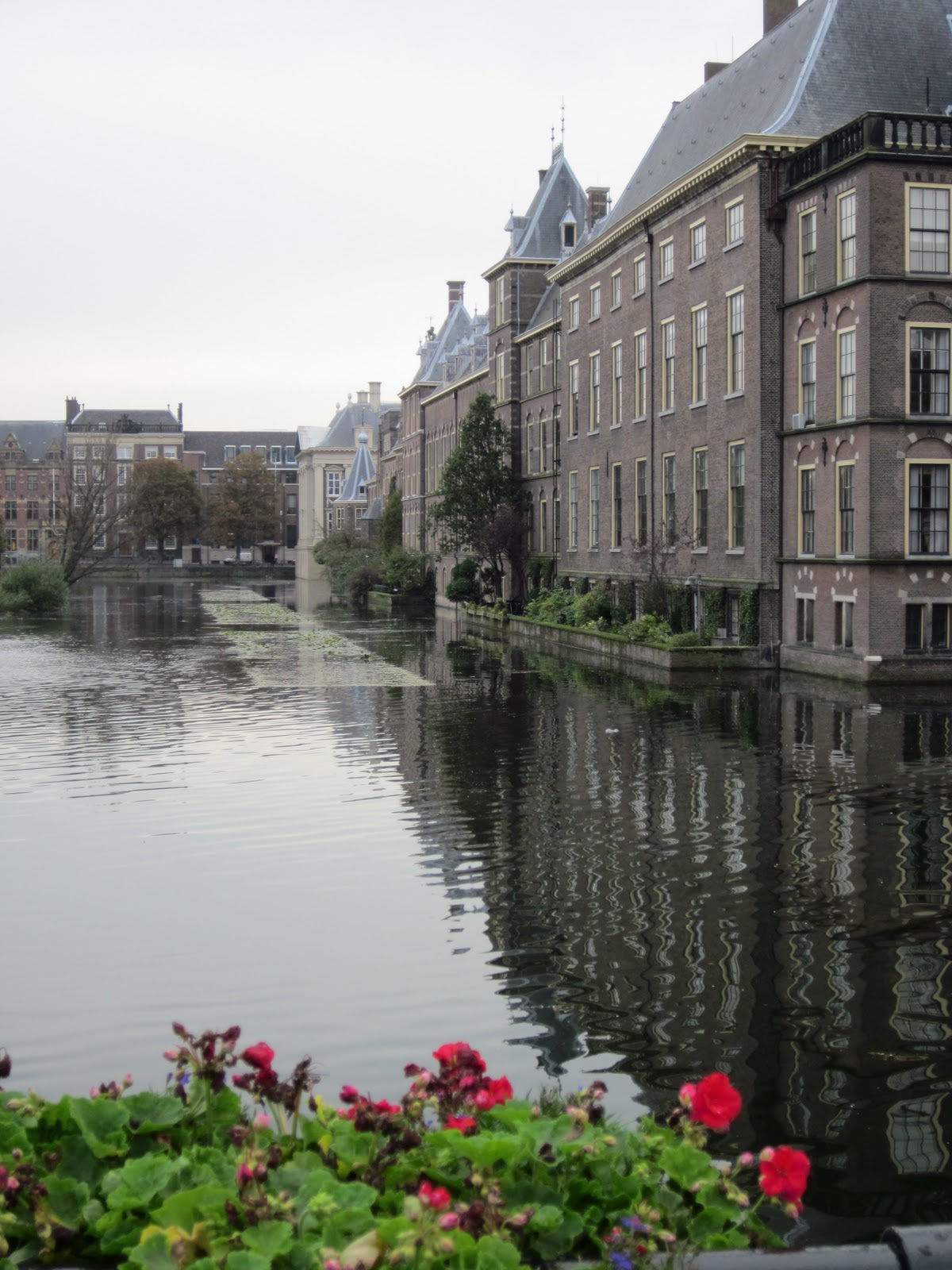
Before these meetings we had some time to explore the city. We discovered things like royal palaces, royal stables, churches, Netherlands government buildings, a plaza dedicated to William of Orange and of course a good amount of cafes. Below is a picture of a beautiful canal that we came across..
I apologize for it being hard to see the flame. The significance of the flame with the surrounding stones should not be lost due to the flames size.
Here is the monastery from behind the gate. Being one of the 7 makers of Trappiste beers they are able to maintain wonderful grounds.
Our long study tour started off the way that study tours typically do, with a long bus ride. After driving all day Sunday we arrived at our hotel at 8:30pm. Not wanting to waste any of our short time in the Hague everyone in the class dropped off their luggage in their room and headed into the city. It being a Sunday evening there was not too much going on, but we did manage to find a plaza with some bars and cafes.Monday morning we were all up for breakfast at 8 am and were on the bus by 9 to head to our various meetings.
Before these meetings we had some time to explore the city. We discovered things like royal palaces, royal stables, churches, Netherlands government buildings, a plaza dedicated to William of Orange and of course a good amount of cafes. Below is a picture of a beautiful canal that we came across..
Below is a picture of another place we found while wandering. Here are The Hague government buildings.
After making many discoveries within The Hague, we headed to the Peace Palace where we were to have a tour. The Peace Palace is home to the International Court of Justice, which is the highest judiciary organ within the United Nations, and the Court of Arbitration. Walking up to the Peace Palace one notices extreme amounts of security measures, the gorgeous yet powerful structure which is the palace, and the World Peace Flame. Around the flame are stones with UN member states names, which are subject to the rulings of the ICJ and court of arbitration.
This is the Peace Palace past the various stages of security. It is absolutely stunning both inside and out. I do not think that I have ever seen a more beautiful building, and within its construction what is designed to be so beautiful is also symbolic of the peace which is the goal of this structure. For example on the outside there are carvings of owls and doves instead of gargoyles; the doves representing peace, and the owls representing wisdom.
Due to security reasons and confidentiality reasons we were not allows to take pictures inside, but oh do I wish I could of. Imagine yourself being in a marble foyer next to a 8 ft stone vase which was a gift from the russian czar in front of marble double stairs that sweep elegantly downwards towards a marble statue of american lady justice in all her glory, standing before italian stain glass windows on an elegant persian rug that has supported the weight of the world's struggles for generations past. That is what it is like to take in the inner sights of the peaces palace. All carpets, art work, and other decorations are donated by member states, containing a large amount of stories in these pieces. For instance there is a statue overlooking the stairs of Jesus. When asking why the ICJ seems to be endorsing one religion over another, a story is told. Two unnamed countries engaged in the elimination of the other's power went to the Court of Arbitration. Here the conflict was settled eliminating the need for further lose of blood. As a symbol of good faith towards the world community and each other, they melted down ammunition from both sides, and created the statue of Jesus which sits at the top of the Peace Palace stairwell. It is for this reason, displaying success of the court that the statue was given such a prominent location within the palace. Below is a picture of myself in front of the peace palace.
After a quick cup of tea in the belly of the Peace Palace, we headed to the International Criminal Tribunal for the former Yugoslavia. Unfortunately no form of electronics are allowed into the building so I was not able to get any pictures. After a lesson on the events leading up to and in the war, we went up to the court to watch a witness testify in the current case before the court.
The observation room was separated from the court proceedings by a bullet proof glass wall. The witness was additionally protected from identification by being curtained off from the observation section. not only this but the voice of the witness was modified to the point that you couldn't tell if its owner was male or female. They really went to extraordinary measures to make sure that this man would be able to testify in the case without fear of being hunted.
After these unique experiences we headed on the bus for Brussels, with a unique experience of a different sort along the way.
In the world of beer there is a type called Trappiste beers. Trappiste beers are made at 7 monasteries within the world. 6 are in Belgium, and 1 called La Trappe is brewed in the Netherlands. On our way to Brussels we were entertained for two hours by the monks at La Trappe, complete with a three course dinner and beer tasting. Needless to say it was a great experience!
The visit to La Trappe ended our class's adventures in the Netherlands. As we traveled contently in our bus away from the monastery we headed across the border, and into the realm of the subsequent post.
Subscribe to:
Posts (Atom)